
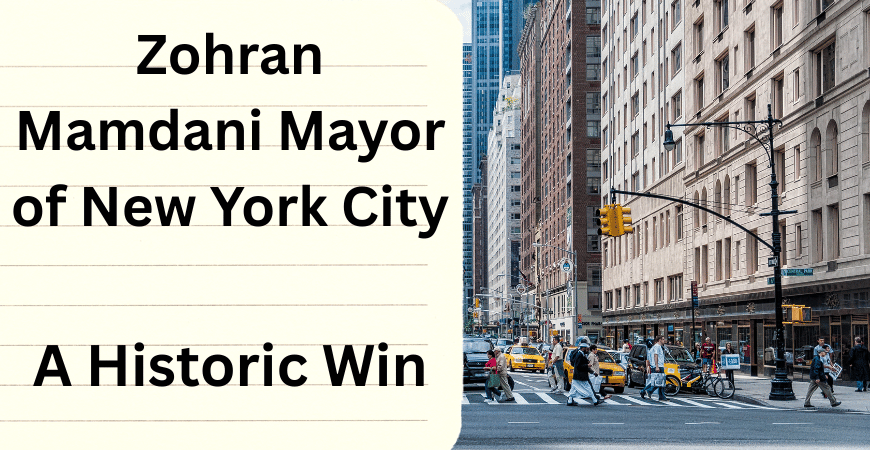
Zohran Mamdani Mayor of New York City: A Historic Win
Historic Significance of Zohran Mamdani as Mayor of New York City
In what many call a turning point for urban politics in America, Zohran Mamdani has been elected as the 111th Mayor of New York City. His win is groundbreaking on multiple fronts — not just for his political platform, but for the demographic and generational change his victory represents. The city, long governed by established power brokers and traditional Democrats, has chosen a fresh face, a different vision, and a promise of bold change.
Who Is Zohran Mamdani?
Zohran Kwame Mamdani, a 34-year-old state assembly member representing Queens, has been described as a democratic socialist, a grassroots organizer, and a millennial upstart who upset the political establishment.
Born in Kampala, Uganda, to an academic father and filmmaker mother, Mamdani immigrated to the U.S. as a child and later attended Bowdoin College.
His professional background includes housing advocacy and working directly with New Yorkers facing eviction, a root that would inform much of his campaign platform.
A Historic Win: Breaking Barriers
Mamdani’s victory is layered with “firsts.” Not only is he the first Muslim mayor of New York City, he is also the city’s first South Asian mayor and the youngest in over a century.
The electorate’s decision appears to reflect both demographic change and generational impatience with status-quo politics. Young voters and first-time voters turned out in force.
Campaign Platform & Key Promises
Mamdani’s platform resonated with many New Yorkers struggling under rising costs of living, housing affordability crises, and a sense of disconnection with mainstream political circles. His core proposals included:
-
Free or fare-free public bus service.
-
A rent freeze on rent-stabilised units.
-
Expansion of affordable housing units city-wide.
-
Tax increases on the city’s wealthiest residents, and corporation tax reform.
These proposals signalled a shift away from moderate incremental reform to more ambitious structural changes in the city’s governance.
The Electoral Upset: From Underdog to Mayor-Elect
Mamdani’s election campaign began as an underdog story. Many polls and analysts initially favoured his opponent, former Governor Andrew Cuomo. But a combination of ranked-choice voting, a strong grassroots digital campaign, and a coalition of younger, progressive voters turned the tide.
On November 4, 2025, Mamdani secured over 50 per cent of the vote in the general election, defeating Cuomo and Republican contender Curtis Sliwa.
His campaign’s usage of social media, small-dollar donations, and local organising proved decisive.
What This Means for New York City
Mamdani’s win signals a new era in New York politics:
-
A shift in power from older, moderate Democrats to younger progressive leaders.
-
A possible realignment of city policy toward bold social programs and wealth-tax measures.
-
Increased national interest in New York as a laboratory for progressive governance.
Still, governing will bring its own hurdles: securing cooperation from state lawmakers, managing massive municipal budgets, and balancing activism with administrative efficiency. Analysts caution that electoral momentum must translate into policy execution.
Challenges Ahead
Even as the euphoria of victory settles, Mamdani faces significant challenges:
-
Building consensus with a city council and state assembly that include centrist and conservative voices.
-
Converting ambitious campaign promises (rent freezes, free transit) into legally and financially viable programs.
-
Navigating New York’s complex public-employee contracts, real estate interests, and fiscal constraints.
-
Addressing public safety, another major concern for New Yorkers, especially given the city’s high-profile crime debates.
How Mamdani balances bold vision with pragmatic governance will determine whether his tenure is remembered as transformative or aspirational.
National Implications: A Blueprint For Progressives
Mamdani’s victory reverberates beyond New York. It energises progressive movements across the U.S., especially in urban centres. His win could shape how the Democratic Party approaches local, state, and national elections — emphasising grassroots mobilisation, youthful candidates and issues of cost of living over traditional centrist governance. PBS
In this sense, his election is being watched by political strategists as a potential template for future campaigns.
Final Thoughts
Zohran Mamdani’s election as mayor of New York City is more than a first for representation; it’s a statement on the aspirations of a changing electorate. He embodies a generational turnover, a call for affordability, and a demand for a fresh approach to governance.
While the path ahead is complex and fraught with institutional resistance, the promise of his election lies in its possibility: that large cities can once again be engines of bold experimentation, social equity, and inclusive leadership.
For more on how the election unfolded and what it means for U.S. urban governance, visit The Guardian’s analysis.
Read Also: Short Form Video Advertising: Best Practices & Tips