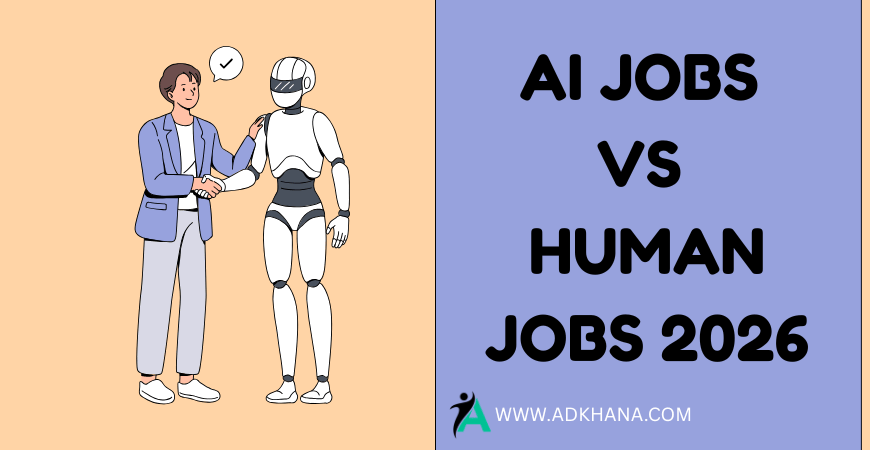
AI Jobs vs Human Jobs 2026
AI Jobs vs Human Jobs – Which Careers Are Most at Risk in 2026?
Artificial intelligence is transforming industries faster than ever before. From content creation and customer support to coding and data analysis, AI tools are now capable of performing tasks that were once considered exclusively human work.
As companies increasingly adopt automation, a major global debate has emerged: Will AI replace human jobs? In 2026, this question is becoming more important for workers, students, freelancers, and businesses around the world.
Experts say AI is unlikely to replace all jobs completely, but it is expected to significantly change how many professions operate. (weforum.org)
🤖 Why AI Is Expanding So Quickly
The rapid growth of AI is being driven by major advances in:
- Large language models
- Automation software
- AI-generated content systems
- Machine learning tools
Modern AI can now:
- Write articles and emails
- Generate images and videos
- Analyze data
- Translate languages
- Assist in coding and research
This has made AI attractive for businesses looking to improve efficiency and reduce costs.
⚠️ Which Jobs Are Most at Risk?
Experts believe repetitive and routine-based jobs are most vulnerable to automation.
🖥️ 1. Data Entry Jobs
AI systems can process and organize information much faster than humans.
📞 2. Customer Support Roles
AI chatbots are increasingly handling:
- FAQs
- Complaint resolution
- Booking systems
- Basic technical support
Many companies are already reducing dependence on large call-center teams.
✍️ 3. Basic Content Writing
Simple SEO articles, product descriptions, and repetitive blog content can now be generated quickly using AI tools.
However, experts note that high-quality journalism, creativity, and expert analysis still require human involvement.
📊 4. Administrative and Clerical Work
Tasks like scheduling, document processing, and report generation are becoming increasingly automated.
💻 5. Some Coding and IT Tasks
AI coding assistants can now:
- Suggest code
- Detect bugs
- Generate templates
While software engineers are still needed, junior-level repetitive programming tasks may decline.
(mckinsey.com)
🧠 Jobs That Are Likely to Survive and Grow
Not all careers are under threat. In fact, some jobs may become even more valuable because of AI.
👨⚕️ Healthcare Professionals
Doctors, nurses, and therapists require:
- Human judgment
- Emotional understanding
- Physical interaction
AI may assist them, but not fully replace them.
🎨 Creative Professionals
Advanced creativity, storytelling, branding, filmmaking, and original design still heavily depend on human imagination.
🧑🏫 Teachers and Trainers
Education involves emotional intelligence, mentorship, and personalized guidance that AI cannot fully replicate.
🔧 Skilled Technical Workers
Electricians, mechanics, plumbers, and engineers performing physical tasks remain difficult to automate completely.
🧠 AI Specialists
Ironically, AI itself is creating new career opportunities:
- AI engineers
- Prompt engineers
- AI safety researchers
- Machine learning specialists
🌍 How AI Is Affecting Freelancers
Freelancers are among the groups most directly impacted by AI tools.
Areas Seeing Major Changes:
- Content writing
- Graphic design
- Video editing
- Translation services
Clients increasingly expect:
- Faster delivery
- Lower costs
- AI-assisted workflows
As a result, freelancers are being pushed to upgrade their skills and provide higher-value services.
📉 Could AI Cause Unemployment?
Some economists warn that automation could reduce demand for certain jobs, especially entry-level office work.
However, history shows that technological revolutions often:
- Eliminate some jobs
- Create entirely new industries and careers
The real challenge may not be job disappearance itself, but how quickly workers can adapt.
🏛️ Governments and Companies Are Responding
Countries and businesses are beginning to prepare for AI-driven workplace changes through:
- Digital skills training
- AI regulations
- Workforce reskilling programs
- Educational reforms
The World Economic Forum has repeatedly emphasized the importance of “reskilling” workers for the AI era. (weforum.org)
📚 Skills That Will Matter Most in the AI Era
Experts believe future workers should focus on skills that AI struggles to replicate:
Important Future Skills:
- Critical thinking
- Communication
- Creativity
- Leadership
- Emotional intelligence
- Complex problem-solving
People who learn to work with AI rather than against it are expected to have better career opportunities.
🌐 AI Is More Likely to Change Jobs Than Destroy Them
Many analysts believe the future workplace will involve:
- Humans + AI collaboration
instead of: - Humans completely replaced by AI
For example:
- Writers may use AI for research assistance
- Doctors may use AI for diagnosis support
- Programmers may use AI for faster development
This means AI could become a productivity tool rather than a total replacement in many industries.
🔮 What the Future Could Look Like
Over the next decade, AI is expected to:
- Automate repetitive work
- Increase demand for digital skills
- Transform education and hiring systems
- Create entirely new career categories
Workers who continuously learn and adapt are likely to benefit the most.
✅ Final Thoughts
The debate over AI jobs vs human jobs is no longer theoretical — it is already reshaping industries in 2026. While some roles face serious automation risks, AI is also creating new opportunities and transforming the way people work.
The future may not belong to AI alone or humans alone, but to people who understand how to effectively combine human skills with artificial intelligence.
Read Also: Pakistan Budget 2026 Relief Expectations