Ali Amin Gandapur Resignation Shakes KP Politics
Ali Amin Gandapur Resignation: A Political Turning Point
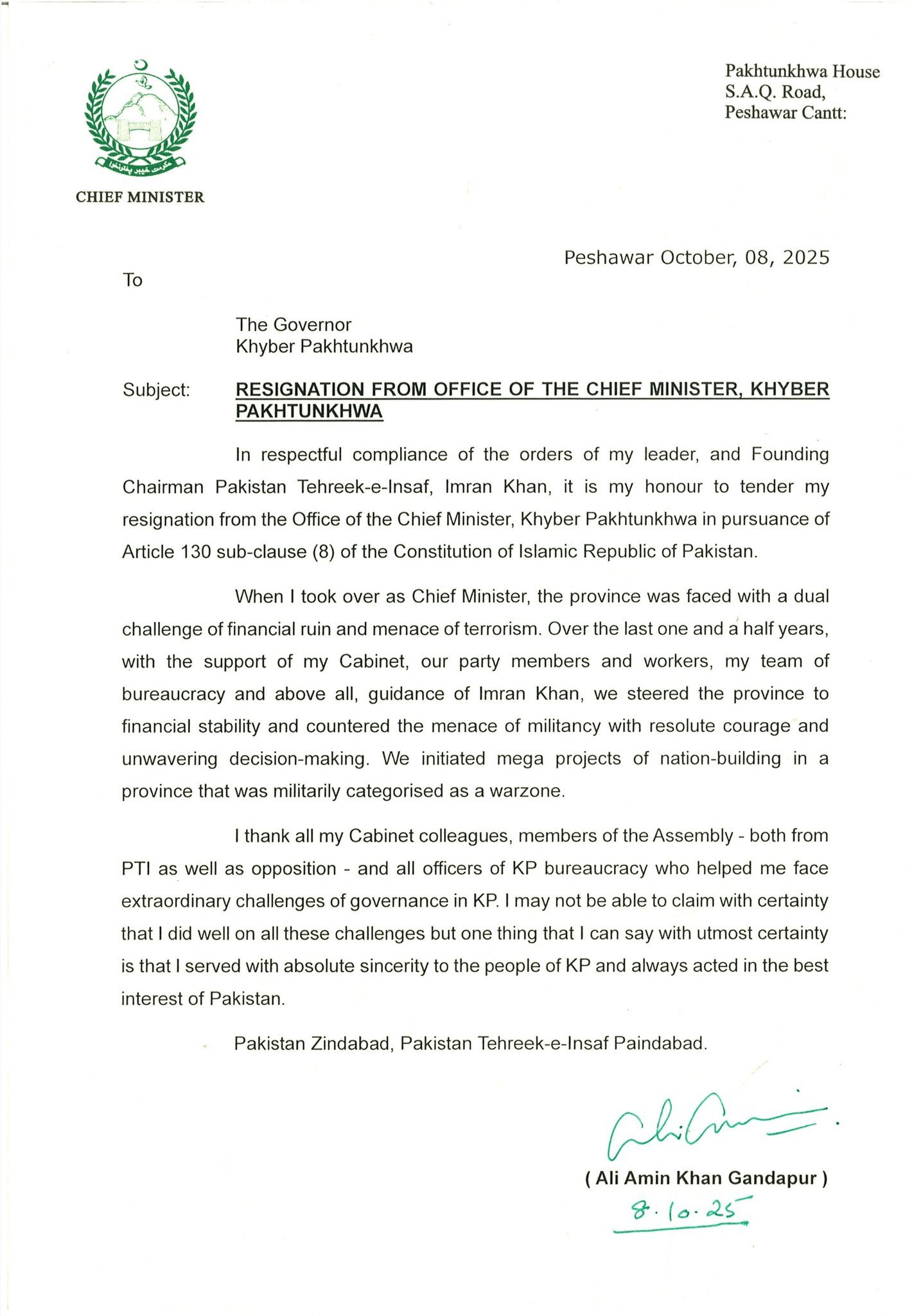
In a major political development in Pakistan, Ali Amin Gandapur has stepped down as Chief Minister of Khyber Pakhtunkhwa (KP) on October 8, 2025, following orders from PTI’s founder, Imran Khan. His resignation marks a significant shift in the PTI’s provincial leadership amid growing criticism over security, governance, and internal party tensions. Sohail Afridi has been nominated as his successor.
Who Is Ali Amin Gandapur & His Tenure in KP
Ali Amin Gandapur, a prominent member of the Pakistan Tehreek-e-Insaf (PTI), became Chief Minister of KP with a challenging mandate. Upon assuming office, the province was grappling with:
-
a fragile financial situation
-
persistent security threats and terrorism
-
underdevelopment in many tribal and border regions
During his tenure, Gandapur sought to implement development initiatives and infrastructure projects, while also attempting to stabilize KP’s finances and bolster counter-terrorism operations. He claimed that, with support from his cabinet and party workers, he managed to steer the province toward greater stability in both governance and security.
Why Gandapur Resigned: Triggering Factors
Several interlocking causes contributed to Gandapur’s departure:
-
Imran Khan’s Directive
The central decision came from the PTI founder himself. Gandapur resigned “in respectful compliance” of Imran Khan’s instructions, describing the position of Chief Minister as a “trust” (amanat) to be returned. -
Security Concerns & Terrorism
The rise in terrorist incidents in KP was cited as one reason for change. PTI leadership reportedly concluded that the current provincial government had not sufficiently distanced itself from the federal government’s policies, which were seen as flawed in their approach to security and refugees. -
Internal Party Tensions
Reports of friction between Gandapur and other PTI figures, including Imran Khan’s sister Aleema Khan, and disagreements over policy direction and administrative decisions surfaced. These internal strains seem to have escalated over time. -
Need for a “Fresh Beginning”
PTI leadership has characterized the change as part of a reset — to bring new energy, possibly new strategies, and to reassert direction amid criticism about governance, policy alignment, and security challenges.
The Process of Resignation & Succession
After Imran Khan’s directive, Gandapur officially submitted his resignation to the KP Governor, Faisal Karim Kundi. The PTI Secretary General, Salman Akram Raja, confirmed that Sohail Afridi would be nominated for the position of Chief Minister. Afridi is an MPA from the tribal districts of the province.
One notable aspect is that the PTI emphasized that there was no need for a no-confidence vote, since Gandapur was resigning voluntarily on instruction.
Reactions & Immediate Impacts
The resignation has triggered political interest and public debate:
-
Supporters of Gandapur have acknowledged his efforts on finance and security, though many also view his departure as inevitable given the internal pressures.
-
Opposition and political analysts are likely to examine whether this change demonstrates PTI’s discipline or reflects instability. Some see it as a move to control narratives and address criticism.
-
KP Government & Administration will now transition under Afridi, which could mean a shift in priorities, or at least a reshuffling of policy emphasis, especially on security and alignment with party founder’s directives.
What This Means for PTI & Provincial Governance
-
Leadership Control & Loyalty
The event underscores how PTI’s internal hierarchy operates: decisions from Imran Khan carry decisive weight, even over high-ranking provincial figures. This may enforce loyalty but can also intensify internal factionalism. -
Policy Direction Shift
Afridi’s induction may come with changes in how KP addresses security, refugee policy, and relations with the federal government, especially given that PTI leadership cited “flawed” federal policies as part of their critique. Dawn -
Security Focus Amplified
With terrorism and law-and-order being flagged as major reasons for change, the new CM will likely have an enhanced mandate to act on security operations, possibly re-evaluate counter-terrorism tactics. -
Public Expectation & Governance Performance
The change raises expectations that the new leadership will perform better — that there will be fewer incidents of militancy, improved public safety, and more visible governance.
Broader Political Significance & Precedents
The resignation sets a precedent in Pakistani provincial politics in terms of leadership change:
-
It shows how central party leadership can order changes even when provincial government holds majority support.
-
It reflects political calculations around electoral politics, public perception, internal coherence, and possibly legal/policy pressures.
-
Occurs in the backdrop of PTI’s broader challenges, including the Toshakhana case, legal issues around party founder, relationship with federal authorities, and tensions among senior figures.
Potential Challenges for the New Leadership
Sohail Afridi steps into a demanding role. His major challenges will likely include:
-
Gaining trust from all factions within PTI—those loyal to Gandapur as well as those aligned more closely with other leaders
-
Managing security crises and demonstrating more effective response to terrorism in KP’s tribal and border regions
-
Addressing the financial issues Gandapur claimed to have made inroads on, but which still remain a concern for many provincial stakeholders
-
Maintaining administrative continuity while possibly introducing new strategies
Conclusion
Ali Amin Gandapur’s resignation as Chief Minister of Khyber Pakhtunkhwa is consequential both for KP’s political landscape and for PTI’s internal dynamics. Driven by security challenges, internal party pressure, and central leadership’s decision, the resignation and the nomination of Sohail Afridi signal a shift. Whether this move can deliver the improvements in governance, security, and stability that many expect remains to be seen.
Read Also: Mitchell Starc Returns to Sydney Sixers for BBL 2025-26